


We Want to Announce Türkiye’s 2040 National Energy Plan to the World Ahead of COP31
Minister of Energy and Natural Resources Alparslan Bayraktar stated, “One of the most important messages we will convey to the world at COP31 is electrification. We believe that electrification is also crucial in the world’s fight against climate change, and as Türkiye, we are preparing our energy vision and plans in line with the new world of electricity.” Minister Bayraktar noted that they intend to announce the 2040 Türkiye National Energy Plan, which they are currently working on, to the world ahead of COP31.
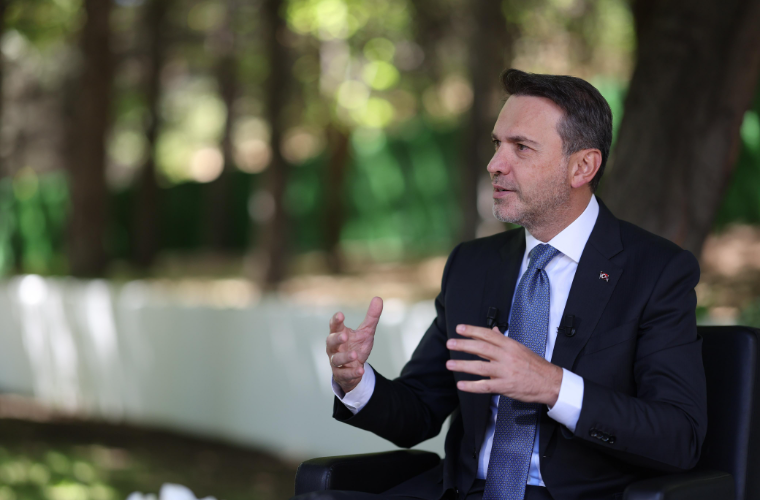

During a live broadcast on CNBC-e, Minister Bayraktar shared his assessments on current issues and outlined the main points of the initiatives Türkiye will present ahead of COP31. Minister Bayraktar summarized his remarks as follows:
COP31 EFFORTS: The message Türkiye intends to convey to the world at COP31 will be: “Let’s move from commitment to action.” We must take action to limit these emissions and meet our climate change goals. I believe COP31 in Antalya will be very successful and will be significant both for Türkiye and for the global fight against climate change. I hope that this metaphor put forward by Türkiye—“Let’s move from commitment to action; let’s take action”—will lead to significant discussions and important decisions. Under the leadership of our President, heads of state, heads of government, and ministers from many countries will be here. We are expecting 100,000 people. From November 9–20, the eyes of the entire world will be on us.
ELECTRIFICATION TAKES CENTER STAGE: One of the most important messages we will convey to the world at COP31 is electrification. One of the goals we have set very ambitiously is a 35 percent electrification target by 2035. If we achieve this, it will truly be a significant accomplishment. We must state clearly that the future belongs to the age of electricity. We believe that electrification is also crucial in the world’s fight against climate change, and as Türkiye, we are aligning our energy vision and plans with this new era of electricity. We are currently working on the 2040 Türkiye National Energy Plan, and we intend to announce it to Türkiye and the world before COP31—likely by the end of October or the first week of November, before COP31 begins. We are placing electrification at the center of this new strategy. To achieve this, Türkiye has very ambitious targets for renewable energy; we had set a target of 120,000 megawatts for 2035. We will set an even larger target for 2040. Türkiye needs to use its energy efficiently. We are currently working on Türkiye’s national energy efficiency action plan—which includes $20 billion in energy efficiency projects through 2030—for the period beyond 2030, and we will set an even more ambitious target.
TRANSPORTATION: A GAME-CHANGER: In Türkiye, we’re talking about an electrification rate of approximately 29 percent in industry and around 22–23 percent in buildings, but one of our key game-changing areas will be transportation. In our national energy plan, we will state the following: By 2035, there should be at least 7 to 10 million electric vehicles on Türkiye’s roads. Our municipalities’ buses must transition to electric vehicles. A significant portion of the personal vehicles we use must transition to electric so that Türkiye’s oil demand can decrease somewhat, and so that through this electrification, we can become a country that reduces emissions and ends our dependence on foreign sources. This requires a massive investment. Our estimates indicate an investment of over 200 billion dollars.
SOLAR AND WIND POTENTIAL: Looking at the potential, it appears that solar will account for 70 percent and wind for 30 percent of total capacity. It’s not a matter of choosing one over the other—we need both. The renewable energy sector is one of our top priorities. We will invest in solar and wind power as much as we can.
HYDROELECTRIC POWER PLANTS: One of our new initiatives involves pumped-storage hydroelectric plants. We have a goal related to pumped-storage, where water is pumped back to the source, drawn out using pumps during off-peak hours to generate electricity, and then used to generate electricity again during times when electricity prices are more favorable.
NEARING COMPLETION AT AKKUYU: We are now nearing the end of the process of generating electricity from the first reactor at Akkuyu. We are currently in the testing phase. Our goal is to begin physical operations at the plant by the end of this year.
OUR PRIORITY IS THRACE: In addition, our negotiations for the Sinop and Thrace power plants are ongoing. In this regard, our ongoing efforts with Canada, particularly in recent months, are progressing rapidly. I hope we will see a clearer picture there in the coming months. We’re looking at both; the Sinop site is a bit more ready, but essentially, our priority in terms of electricity is in Thrace. We need to complete the Thrace project a bit sooner. Fieldwork is also continuing there. We’re in talks with China, Russia has shown significant interest, and our negotiations with South Korea are also ongoing in this regard.
NEW DRILLING IN THE BLACK SEA: We have increased our number of deep-sea drilling vessels to 6. One of them is currently operating in Somalia. In addition to the production development program, another vessel is conducting new drilling operations in the fields we have identified in the Western, Central, and Eastern Black Sea. In the coming days, we will begin a drilling operation targeting oil. It will be a challenging operation that will take some time. We will soon begin an oil-targeted drilling operation in the Western Black Sea.
POLITICAL WILL IS NEEDED FOR QATAR GAS: The project we are considering—to transport Qatar gas to Türkiye and, in part, through Türkiye to Europe—is one of the initiatives that will make a significant contribution to global gas supply. A pipeline approximately 2,000 to 2,200 kilometers long is required for Qatar gas. Of course, the financing and the technical aspects of constructing the solution are very important, but political will and a firm political stance were necessary to build TANAP and TAP. Thanks to the contributions of our President, Mr. Aliyev, and other countries, along with the support of the European Union, this was achieved. In other words, political will must be established first. We need to create that in a similar way for Qatar. Countries need to believe in this. The stance of Qatar, Türkiye, and the European Union on this issue is also important. Everyone is looking for an alternative. I view this time as a period when a crisis can be turned into an opportunity, and new projects can be brought to life alongside this crisis.
POTENTIAL FOR A HUB IN CEYHAN: There is potential to transform Ceyhan into an oil hub. In fact, if we can find additional oil sources here, we might even be talking about the potential to reach 2 to 2.5 million barrels. If you take Iraq’s daily exports of 3 million barrels and Kuwait’s 2 million barrels—say, “5 million barrels”—and aim for 50 percent of that: half of 5 million barrels, or 2.5 million barrels, could easily be transported to Europe via Türkiye. We also note that by integrating storage at Ceyhan with refining and petrochemicals, we could create an even larger value chain for Iraq and other countries in the region.