


Oruç Reis Arrives in Pakistan for Its Second Overseas Mission
Developed in Türkiye using domestic resources and expertise, the Oruç Reis Seismic Survey Vessel has docked at the Port of Karachi ahead of its second overseas mission, following its first intercontinental assignment in Somalia. To mark its arrival, a ceremony will be held in Pakistan tomorrow (20 November) with the participation of Minister of Energy and Natural Resources Alparslan Bayraktar. Oruç Reis will survey two separate areas in Pakistani waters, collecting 3D seismic data across 670 square kilometres and 2D seismic data along 2,353 kilometres of survey lines.
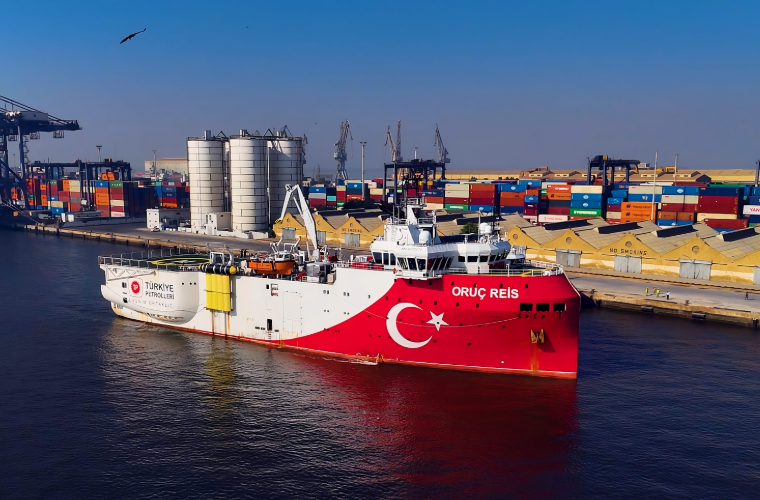

“As a country with the world’s fourth largest deepwater drilling fleet, we aim to build on the expertise we have gained in deepwater exploration and achieve new successes by joining forces with our friend and brother Pakistan,” Minister Alparslan Bayraktar said. “With this operation, our vessel, which embodies our nation’s unwavering determination to achieve energy independence, will once again show the world the strength of our nation and the capabilities of Turkish engineering.”
Türkiye is pressing ahead with hydrocarbon exploration at home and abroad and is preparing to launch another offshore exploration campaign overseas.
Pakistan Is the Next Assignment
Oruç Reis will conduct seismic surveys in Pakistan following its first intercontinental mission in Somalia, which laid the groundwork for the ongoing drilling operation by the Çağrı Bey Deepwater Drilling Vessel.
Arrival at the Port of Karachi
Oruç Reis set sail on 30 October after completing preparations at the Port of Taşucu in Mersin. It has now arrived at the Port of Karachi in Pakistan.
2D and 3D Seismic Surveys in Two Areas
In a statement on social media, Minister Alparslan Bayraktar said:
“Our nationally built Oruç Reis Seismic Survey Vessel, a source of pride for our country and the work of Turkish engineers, has arrived in Pakistan for its second intercontinental mission. Oruç Reis has already gathered valuable data by surveying 23,000 kilometres in our Blue Homeland and covering 4,464 square kilometres off Somalia. We are now beginning hydrocarbon exploration in Pakistan’s offshore areas. As part of this new mission, the vessel will collect 2D and 3D seismic data in two areas.”
Showcasing Turkish Engineering
Minister Alparslan Bayraktar added:
“As a country with the world’s fourth-largest deepwater drilling fleet, we aim to build on the expertise we have gained in deepwater exploration and achieve new successes by joining forces with our friend and brother Pakistan. With this operation, our vessel, which embodies our nation’s unwavering determination to achieve energy independence, will once again show the world the strength of our nation and the capabilities of Turkish engineering.”
Ceremony to Mark the Vessel’s Arrival
A ceremony will be held in Pakistan tomorrow (20 November) to mark the arrival of Oruç Reis, with Minister of Energy and Natural Resources Alparslan Bayraktar in attendance. The vessel will leave port for its assignment once final preparations are complete.
Marjan 3D
Oruç Reis will first carry out the Marjan 3D Seismic Project in the Indus-C Block, collecting 3D seismic data across 670 square kilometres off Karachi. Preparations and data collection are expected to take approximately 50 days after the vessel reaches the survey area.
Makran 2D
After completing the first survey, Oruç Reis will return to the Port of Karachi to prepare for its next operation. Its second assignment in Pakistani waters will be in the Makran Blocks. Under the Makran 2D Seismic Project, the vessel will collect 2D seismic data along a total of 2,353 kilometres of survey lines. Work in the Makran Blocks is expected to take 25 days.
Oruç Reis Laid the Groundwork for Drilling in Somalia
Oruç Reis successfully completed its first intercontinental mission in Somalia, which lasted nine months. The 3D seismic data it collected across 4,464 square kilometres in three offshore blocks paved the way for Türkiye’s first deepwater drilling operation abroad.
A Purpose-Built Survey Vessel
Turkish engineers built Oruç Reis in 2017 using domestic resources and expertise. In addition to exploring for natural resources, the vessel can be used to study the continental shelf and the Earth’s crust. It can conduct both 2D and 3D seismic surveys for offshore oil and gas exploration. The purpose-built vessel is 87 metres long, 23 metres wide and 34 metres high.