

Oruç Reis Takes on Major Mission in Pakistan
Minister of Energy and Natural Resources Alparslan Bayraktar attended a ceremony at the Port of Karachi to welcome the seismic research vessel Oruç Reis, which will collect seismic data in Pakistan’s territorial waters. Speaking at the ceremony, Minister Alparslan Bayraktar said, “Our work onshore and offshore in Pakistan will directly strengthen the security of energy supply in both countries and contribute to the prosperity of our peoples. We have discovered hydrocarbons and brought them into production in our own waters. We want to achieve the same success in Pakistan.” He added that the aim was to begin drilling next year at sites identified using the survey data.
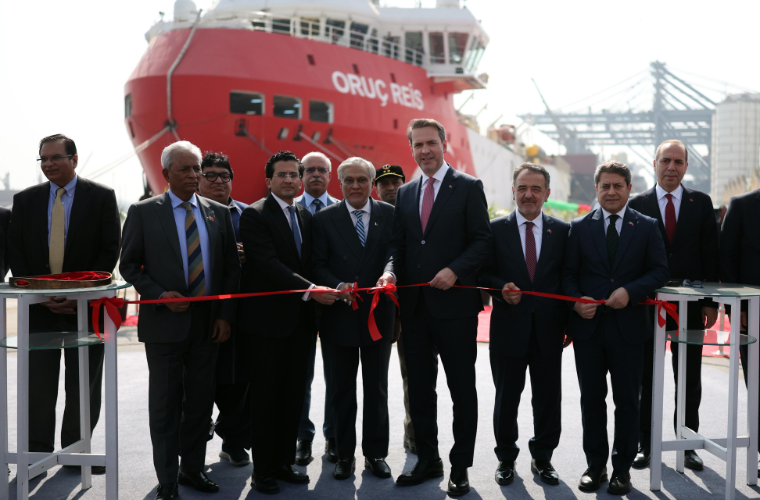

Developed in Türkiye using domestic resources and expertise, Oruç Reis arrived in Pakistan for its second overseas operation after completing its first intercontinental mission in Somalia. A welcoming ceremony was held at the Port of Karachi, where the vessel docked.
Minister Alparslan Bayraktar in Pakistan
Pakistan’s Deputy Prime Minister and Foreign Minister Mohammad Ishaq Dar and Minister for Petroleum Ali Pervaiz Malik joined Minister Alparslan Bayraktar at the ceremony.
“Our Two Nations Share Deep Bonds of Brotherhood”
Minister Alparslan Bayraktar said that those gathered in Karachi were witnessing a historic moment in energy relations between Türkiye and Pakistan and taking the first concrete step in a new era.
“Our two nations share common values and deep bonds of brotherhood. The strength of the bond between our countries comes from centuries of shared history and the genuine affection our peoples feel for one another. We have come together today to take a historic step that will deepen our friendship and shape the energy future of both countries,” he said.
The Indus and Makran Basins
Minister Alparslan Bayraktar said that Oruç Reis had come to Pakistan to assess the hydrocarbon potential beneath the Indus and Makran basins. He noted that the agreements signed in Islamabad last year had established a strong partnership between Turkish Petroleum (TPAO) and Pakistan’s leading national energy companies, OGDCL, PPL and Mari Energies.
“We have taken this partnership into the field. We have completed the licensing process for five blocks, three offshore and two onshore, and have begun fieldwork. TPAO will use Oruç Reis to acquire 3D seismic data across 670 square kilometres of the Indus C Block. We expect the survey to take 52 days, or about two months,” he said.
“We Aim to Begin Drilling Next Year”
“God willing, we aim to begin drilling next year at sites we identify using the data we collect. I hope our efforts lead to discoveries that contribute to the development of both countries,” Minister Alparslan Bayraktar said.
“We Want to Achieve the Same Success in Pakistan”
Minister Alparslan Bayraktar said the work in Pakistan had taken on even greater strategic importance as global oil and natural gas markets faced the largest supply shock in their history.
“Our work onshore and offshore in Pakistan will directly strengthen the security of energy supply in both countries and contribute to the prosperity of our peoples. We have discovered hydrocarbons and brought them into production in our own waters. We want to achieve the same success in Pakistan,” he said.
“We Firmly Believe This Work Will Strengthen the Longstanding Friendship Between Our Two Nations”
Minister Alparslan Bayraktar recalled that Türkiye had discovered the largest natural gas reserve in the Black Sea in 2020.
“Today, we produce around 10 million cubic metres of natural gas a day from these fields, enough to meet the natural gas needs of some 4 million households. In 2028, we will raise daily production to around 40 million cubic metres, enough to supply 16 million households. We have come here to put the experience and engineering expertise we gained through this work at the service of our Pakistani brothers and sisters. We in Türkiye firmly believe that our work here will strengthen the longstanding friendship between our two nations,” he said.
“We Are Open to New Partnerships”
Minister Alparslan Bayraktar said the two countries should build on the steps they had already taken, noting the considerable scope for cooperation in energy and mining.
“Today, we will also witness the signing of new agreements between our national mining companies and institutions. These agreements mark a further step towards a broader partnership. We have many opportunities ahead of us, and we should work together to realise them. All our institutions are open to new partnerships,” he said.
Minister Alparslan Bayraktar concluded his remarks by saying, “Long live Pakistan! Long live Türkiye! Long live the friendship between Pakistan and Türkiye!”
Three Mining Agreements
Following the ceremony, Minister Alparslan Bayraktar presided over the signing of three mining agreements between Türkiye and Pakistan.
MTAIC to Explore for Minerals at Three Sites
MTAIC, established jointly by two of Türkiye’s leading mining institutions, the General Directorate of Mineral Research and Exploration (MTA) and Eti Maden, signed two separate joint venture agreements with Pakistani mining companies Mari Energies Minerals and the Pakistan Mineral Development Corporation (PMDC). Under the agreements, MTAIC will begin exploring for copper and gold at two sites in Pakistan and for antimony at a third.
Trilateral Memorandum of Understanding
MTA, MTAIC and the Geological Survey of Pakistan also signed a trilateral memorandum of understanding. The parties aim to share more technical knowledge and experience in geology and mineral exploration and to develop joint projects.
At sites where exploration yields positive results, the parties intend to pool their technical expertise and work together across all stages of development, from mining and ore processing to the manufacture of finished products.
Diversifying Sources of Supply
The agreements aim to create jobs in Pakistan, increase the value added locally and contribute directly to the country’s economy. For Türkiye, the aim is to diversify sources of critical minerals, particularly antimony, and strengthen the mining sector’s capacity to develop international projects.